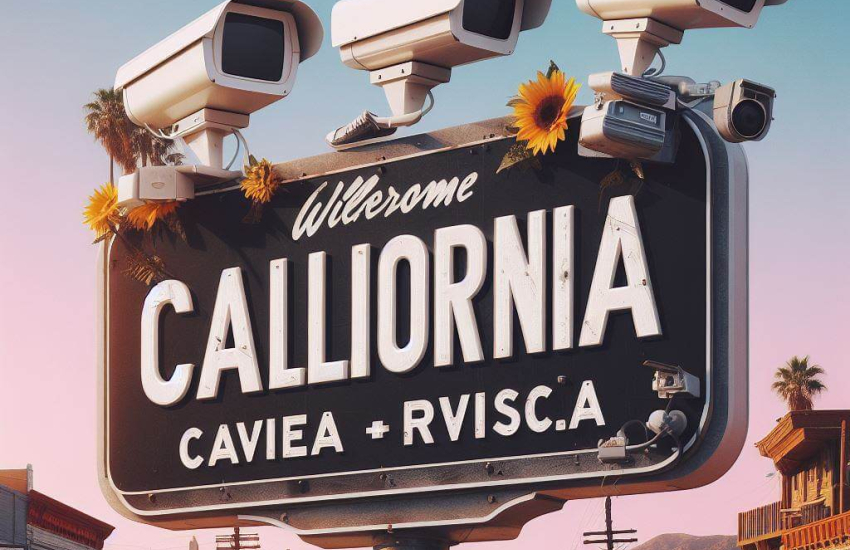
As the most populous state in the USA, California is a huge business hub. Whether you are running a small company in a neighbourhood or the owner of a multi-state business with premises in CA, there are many state rules you must abide by.
Surveillance cameras are the key security measure in any premise of today’s world. You can’t deny their effective and practical solution to tackling threats, nullifying dangers, getting faster reports of the workplace, or an overall better lookout. But like in other states, one must learn and follow the surveillance laws in California before using this security measure.
Familiarize yourself with these rules and regulations regarding surveillance in California in this article so that you don’t run into any legal complications in your business.
California’s Legal Landscape
California is an all-party consent state. That means that when planning to record any premise or something, one must obtain the consent of all parties under surveillance. The correct and lawful way to take this consent is to put up a notification at the entrance or make them aware verbally. Anyone entering the property afterwards will be legally consenting to it.
You can find the above rule in the California Penal Code §632. It doesn’t matter what your reason for recording is, including the recording of any threatening call or crime occurring. Unless you have consent from all parties, recording them (video or audio) or monitoring them by video is a violation of the rule.
The penalty for this offence is up to one year in jail and up to $2,500 per violation. If the person getting recorded or surveilled files a civil suit, the penalty can go up to $3,000 per violation.
Of course, other areas in California law cover guidelines for different businesses and property owners. For instance, if you are an apartment owner with plans to integrate security cameras on your property for tenants, you should check Penal Code §647.
Meanwhile, one must get a contractor’s license before installing surveillance cameras and devices on public properties. Upon receiving the license, a contractor must keep it displayed and visible under all their advertisements or anywhere they put their name or logo on.
If you are hiring a contractor for surveillance installation in California, it is ideal to check whether they have a license or not. They must also be able to show you a license number given to them by the California State License Board.
Another CA law prohibits you from keeping recordings for more than 90 calendar days.
Aside from these, you also need to consider the Federal laws regarding surveillance systems. Some of them are-
California has been trying to maintain a proper balance between privacy and security regarding surveillance cameras. It is so because, while these cameras provide excellent security against all kinds of threats and crimes, they may also breach the privacy of the individuals being monitored. So, there have been occurrences where the judge, jury, or the law had to put up a balance.
One such example was when the neighbour of Kathy Griffin and her boyfriend Randy Bick filed a lawsuit against them. The couple recorded their neighbour’s yard with their security cameras in order to use it as evidence after getting annoyed by the latter’s loud party music.
However, while it may seem like all odds were against the couple, the court declared that it wasn’t a violation of privacy. It stated, “Only a small portion of plaintiffs’ (the neighbour) backyard could be seen, plaintiffs and their guests could barely be seen, and the content of their conversations could not be discerned”.
The case went in favor of Kathy Griffin and her boyfriend because their actions didn’t breach their neighbour’s privacy.
In another case, the California Supreme Court prohibited the privacy breach of the employees by surveillance cameras with the following statement-
“While privacy expectations may be significantly diminished in the workplace, they are not lacking altogether.”
Since the law states that one mustn’t put cameras in places with privacy expectations, many employers often take that as a green light to install them anywhere else on their premises. However, they must be careful and consider many factors before installing security cameras.
Semi-private areas like the break rooms or places where an employee has a somewhat reasonable expectation of privacy may also fall within the privacy rules. So, an employer shouldn’t monitor or record any area before they are entirely sure that those areas are totally public places, not private or semi-private.
While most surveillance laws in the state of California are the same for most industries, there can be some minor exceptions or additions in specific ones. Let’s go over some such examples-
Retail or Shopping Malls
In retail or shopping malls, the shopping and selling areas should always be under surveillance. Yes, it is not optional but mandatory. It is so because crimes regarding retail shops are frequent in most populous cities and states.
As such, California requires its licensed retailers to keep their goods and transaction sections under watch with cameras and recordings. However, the recording footage can only be stored in any device for 90 days at most. Afterwards, it must be deleted, or it will be a privacy breach.
Educational Institutions
The academic premises in California have strict laws regarding using surveillance cameras or audio recording devices. Some of them are as follows-
For more information, check this out.
Healthcare Institutions
California law or the federal codes don’t have many specific rules about healthcare surveillance systems. However, there are other rules you may have to consider. They fall within the protected health information (PHI) category under HIPAA laws.
Cannabis Business
Due to the high rate of theft and other crimes related to the cannabis business, the law in California made it imperative to use surveillance cameras in them. The selling points, goods, handling of the products, and transactions must all be under proper surveillance at all times. The pixel of the camera resolution must be at least 1280 x 720.
Keeping Up with Compliance
With the never-ending technological advancement, different forms of crimes and threats are also growing. As such, the laws are also adapting and changing in accordance. But it also tries to keep the privacy factor intact.
In order to keep up with compliance with all the changes in the law, a business should be cautious about the regulations. The authorized body must check the state rules every once in a while. It doesn’t hurt to be extra careful by looking up the state laws of one’s particular business occasionally.
One can also hire legal advisors to keep them updated about any alteration of the regulations. Finally, businesses should stay on the safer side by not integrating surveillance in places that may or may not be private.
FAQs
Are Video Surveillance Recordings Legal in California?
Yes, video surveillance recordings are legal in California, given that they follow the appropriate regulations. For example, recordings of private places are illegal. Similarly, the recordings must be handled carefully. Some places, like healthcare institutes, require the identity of innocent individuals to be kept hidden.
What Are Residential Video Surveillance Laws in California?
In California, one can install cameras in one’s own residence in order to monitor garages, driveways, yards, or inside the house. When guests arrive, the owner must notify them of the cameras but has no obligation to tell them about their locations. No cameras must be placed or pointed at private places, such as bathrooms.
Do Businesses Need Video Monitoring in California?
Specific businesses in California must install surveillance cameras on their premise and keep any form of selling, stocking, or storage under watch. One such example is the cannabis business.
Conclusion
Since California is relatively populous, its laws about surveillance are also strict. This all-party consent state requires anyone to notify others when they are being monitored or recorded, no matter the reasons. Any form of privacy breach is illegal, even if it is one’s employees or guests.
Businesses or landlords can keep themselves familiar with the legal codes and abide by them always to avoid any legal hurdles.